
Career Reframe
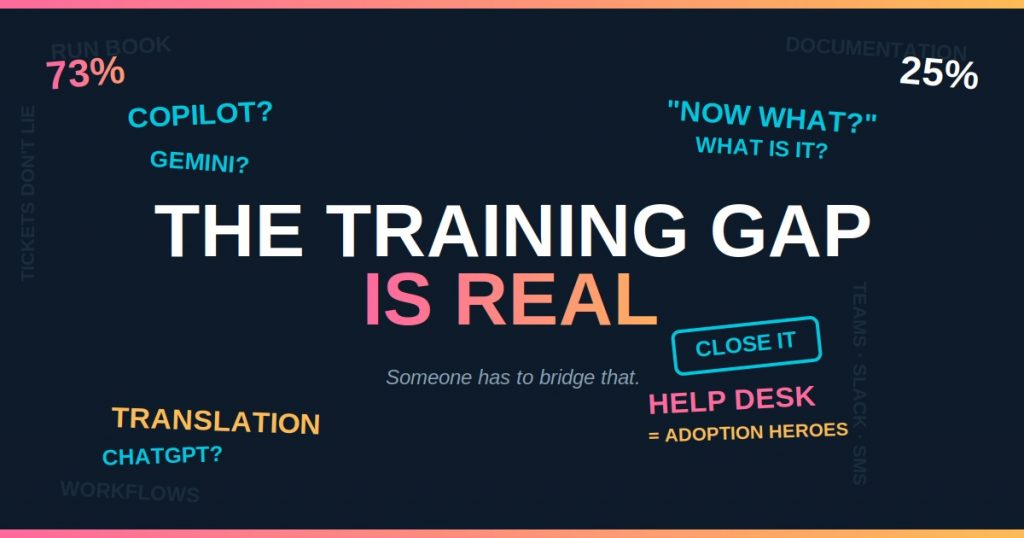
A training gap is the distance between the skills employees have and the skills their job now requires. Seventy-three percent of CEOs list AI adoption as a top priority. Only 25 percent of workers say their employer has given them formal training on it. That gap does not close itself. Someone fills it by default.
Most companies handle training gaps the same way: an online module, a meeting, a one-hour session on a new tool or policy. I have sat through years of these, on both sides of the review table. The intent is right. The execution rarely sticks. A single session does not create adoption, and it never has.
When adoption does not happen on its own, it lands on help desk and desktop support. We are the ones fielding the real questions once the rollout is done: what is Copilot, how do I use it, it gave me the wrong answer, now what. Those calls, emails, and Teams messages start the same day the training ends.
Strategy and Execution Are Not the Same Thing
Eighty-five percent of employers say they plan to prioritize reskilling. Only 38 percent of companies actually offer AI training, according to D2L’s 2026 employee training data. Fifty-eight percent of employees already use AI at work regularly, most without any formal instruction. The strategy and the execution are two different things, and the gap between them is where I have spent my career.
How I Actually Close It
Job postings for IT support still lead with Windows 10/11, VPN configuration, and remote support as the core hard skills. Those are the visible parts of the job. The less visible part is what I do before a new tool ever reaches a user. I take the training, then I sit with the software and click through it the way a confused end user would. I ask the basic questions on purpose. Will this actually automate the task it claims to automate? Does it hold up in a real workflow, not just a demo? I run it through a task common to my user population, one it was advertised to handle well, and I document every step and every result.
Once the tool is live and the calls start, that testing pays off. I can tell someone whether their workflow is right or wrong, fix what is actually broken, and clean up the documentation so it holds up the next time someone hits the same wall. That documentation becomes an email the team can send, a post on the internal wiki, or a line in the run book. It is not a one-time fix. It is the thing that keeps the next hundred people from having to call in at all.
Companies do not have an AI strategy problem. They have a translation problem, and that has been my job title the whole time, whatever it said on the door.